After 25 years of coaching, this is the question I get more than any other: how many calories to lose fat? People want a magic number, and I understand why. The good news is the core answer is simple. The honest answer is that your exact number is personal, and the type of calories you eat decides whether you lose fat or lose muscle.
So let us do this properly. I will explain calories, deficits, and macros in plain English, show you why protein is the piece almost everyone gets wrong, and then hand you off to the calculator that gives you your real number.
The short answer: to lose fat, you eat fewer calories than your body burns. That is a calorie deficit, and it is the only thing that actually reduces body fat. No food, supplement, or workout gets around it.
The real answer: how big that number is depends on your size, your activity, your muscle mass, and your goals. A 130-pound office worker and a 210-pound construction worker do not eat the same amount to lose fat. That is why the smart move is to understand the concepts here, then let the calculator do the math for your body.
A calorie is just a unit of energy. Food is fuel, and calories are the measure of how much fuel a given food provides. Your body spends that energy all day long, whether you are running sprints or sitting still reading this. Breathing, digesting, thinking, and moving all cost energy.
The total amount your body burns in a day has a name: your maintenance calories, sometimes called TDEE (total daily energy expenditure). Eat at maintenance and your weight holds steady. Eat below it and you lose. Eat above it and you gain. Everything else is detail on top of that foundation.
When you eat less than you burn, your body has to cover the gap somehow. It does that by tapping into stored energy, which is body fat. That gap is the deficit, and it is where fat loss lives.
Here is the part people get wrong: bigger is not better. Slashing your calories to the floor feels productive, but a savage deficit backfires. You lose more muscle, your energy tanks, your hunger spikes, and you burn out and rebound. A sensible deficit, somewhere in the range of 300 to 500 calories below maintenance for most people, or roughly 10 to 25 percent, lets you lose fat at a steady pace of about half a percent to one percent of your bodyweight per week while feeling like a functioning human. Slower and sustainable beats fast and miserable every time.
If you have been eating in a deficit and still are not seeing the scale move, that is usually a specific, fixable issue, not a broken metabolism. The Fat Loss Quiz can pinpoint which blocker is stalling you.
Technically, you could hit your calorie deficit eating nothing but cake and still lose weight. People have done it as a stunt. But here is what that misses: calories decide how much weight you lose, and the makeup of those calories decides what you lose and how you feel doing it.
Eat in a deficit with almost no protein and a pile of sugar, and a big chunk of the weight you drop will be muscle, not just fat. You will get smaller, softer, weaker, and hungrier. Eat the same number of calories with enough protein and real food, and you protect your muscle, stay fuller, and end up looking and performing the way you actually wanted to. Same scale weight, completely different result. That is why the next piece matters so much.
Here is the piece most calorie articles skip. When you are in a deficit, your body goes looking for energy to cover the gap, and it does not only reach for fat. Muscle is on the table too. Muscle is expensive to maintain, so when your body is short on fuel and sees no reason to keep it, it will burn some of it for energy. That is exactly what you do not want. Losing muscle leaves you softer, weaker, and slower, and it lowers the number of calories you burn at rest, which makes staying lean harder later.
The good news is you are not a passenger here. You get to tell your body to protect muscle and pull from fat instead, and you do it with three levers:
Same deficit, but now you have stacked the deck. The weight you lose comes off as fat, and the muscle you worked for stays where it belongs. Which brings us to the fuel that makes it all run.
Macros, short for macronutrients, are the three things that make up the calories in your food:
Notice that fat carries more than double the calories per gram of protein or carbs. That is not a reason to fear it, it just explains why a little fat goes a long way on your calorie total. Your total calories set whether you lose fat. Your macros, especially protein, set the quality of that fat loss.
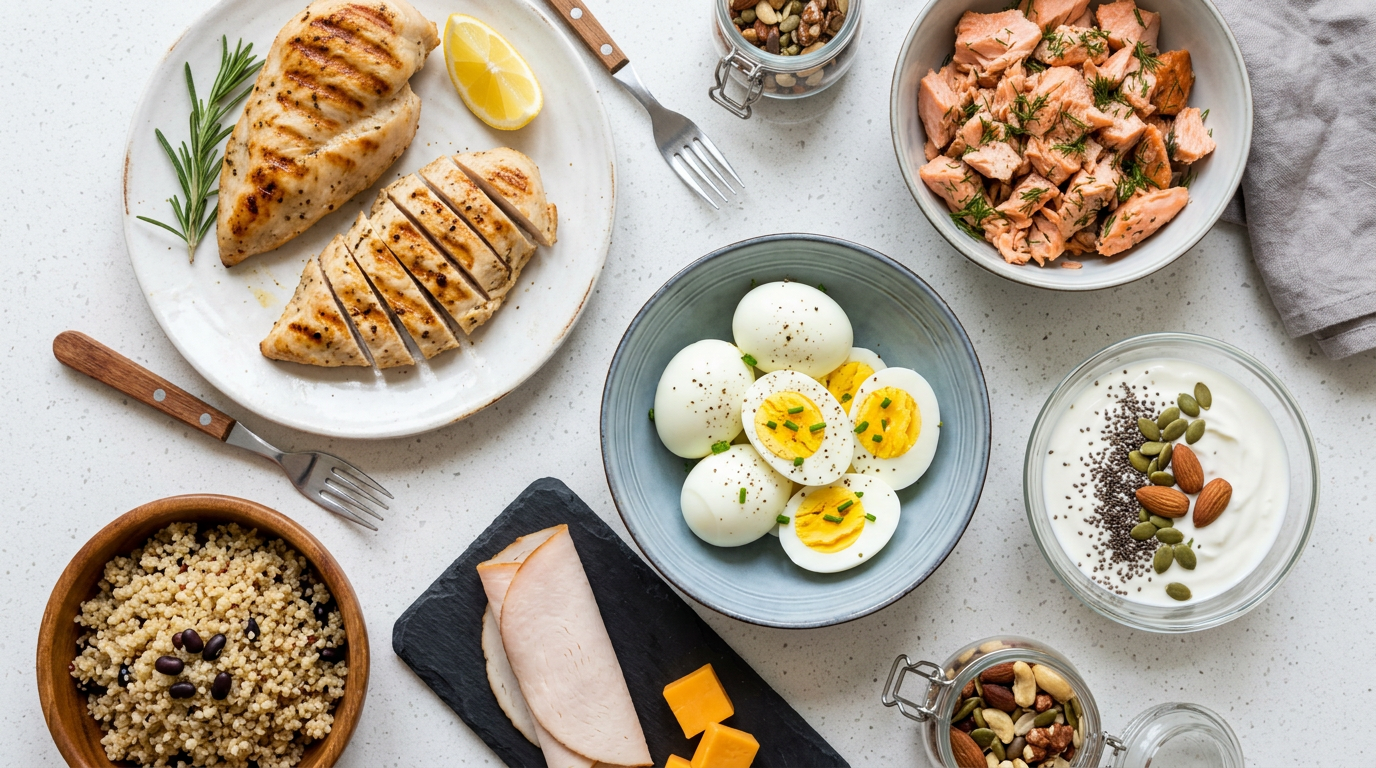
If you remember one thing from this entire article, make it this: when you are in a deficit, protein is what protects your muscle. It is the single most important macro for anyone trying to lose fat and still look strong.
The research here is not shaky. A 2012 meta-analysis of 24 controlled trials with more than 1,000 people found that higher-protein, calorie-restricted diets preserved more lean mass and lost more fat than standard-protein diets (Wycherley et al., 2012, American Journal of Clinical Nutrition). For how much protein actually maximizes muscle, a large 2018 review of 49 studies and 1,863 people landed on roughly 1.6 grams per kilogram of bodyweight per day, which is about 0.73 grams per pound (Morton et al., 2018, British Journal of Sports Medicine). Leaner people dieting hard often benefit from going higher still, up to around 2.3 to 3.1 grams per kilogram of fat-free mass (Helms, Aragon and Fitschen, 2014, Journal of the International Society of Sports Nutrition).
At IGNIT3, here is the practical target we give people: 0.6 to 1 gram of protein per pound of lean body mass. If you do not know your lean body mass, a simple stand-in is 0.7 to 1 gram per pound of your goal bodyweight. For a 180-pound person carrying around 20 percent body fat, that works out to roughly 115 to 145 grams of protein a day. Hit that, and you have covered the most important nutrition decision you will make in a fat-loss phase.
Bonus
Protein is also the most filling macro and the most expensive for your body to digest, so a high-protein diet keeps you fuller on fewer calories. It quietly makes the whole deficit easier to stick to.
Here is where it gets exciting. Get your protein and training right, and you do not just hold onto muscle in a deficit. You can sometimes build it while losing fat at the same time. That is body recomposition, and it is not a myth.
In one standout 2016 trial, young men ate in a steep 40 percent calorie deficit for four weeks while training hard. The group eating high protein gained lean muscle and lost more fat at the same time, while the lower-protein group mostly just maintained (Longland et al., 2016, American Journal of Clinical Nutrition). Recomposition works best for people who are newer to training or carrying more body fat, and it slows down the leaner and more advanced you get. But the takeaway is universal: high protein plus resistance training changes what a deficit does to your body.
Once protein is set, the rest is more flexible than the internet makes it seem. Carbs and fat mostly come down to preference, performance, and what you can stick to. A common, sensible starting split for fat loss looks like this:
If you train hard, lean toward more carbs to fuel your sessions. If lower-carb eating keeps you fuller and more consistent, shift some of those calories toward fat instead. Both work, as long as protein stays high and total calories stay in a deficit. Do not overthink the carb-to-fat ratio. Nail protein and calories first, and the rest is fine-tuning.
Everything above is universal. Your actual number is not. The concepts do not change, but the calories and grams that fit your body, your activity, and your goal are yours alone, and guessing at them is how people spin their wheels for months.
So do not guess. The IGNIT3 MACRO Calculator sets your fat-loss calories and macros, protein included, in about two minutes. It does the math this article just taught you, personalized to you.
Want the diagnosis side too? If you are not sure what is stalling your progress, take the Fat Loss Quiz, and if you would rather have this handled for you, our VIP Nutrition Coaching builds the whole plan around your body and your life.
Fat loss is not a mystery, and it is not about willpower or the latest diet. It is a moderate calorie deficit, plenty of protein, and enough patience to let it work. Learn the concepts once and you never have to fall for a gimmick again. Now go get your number.